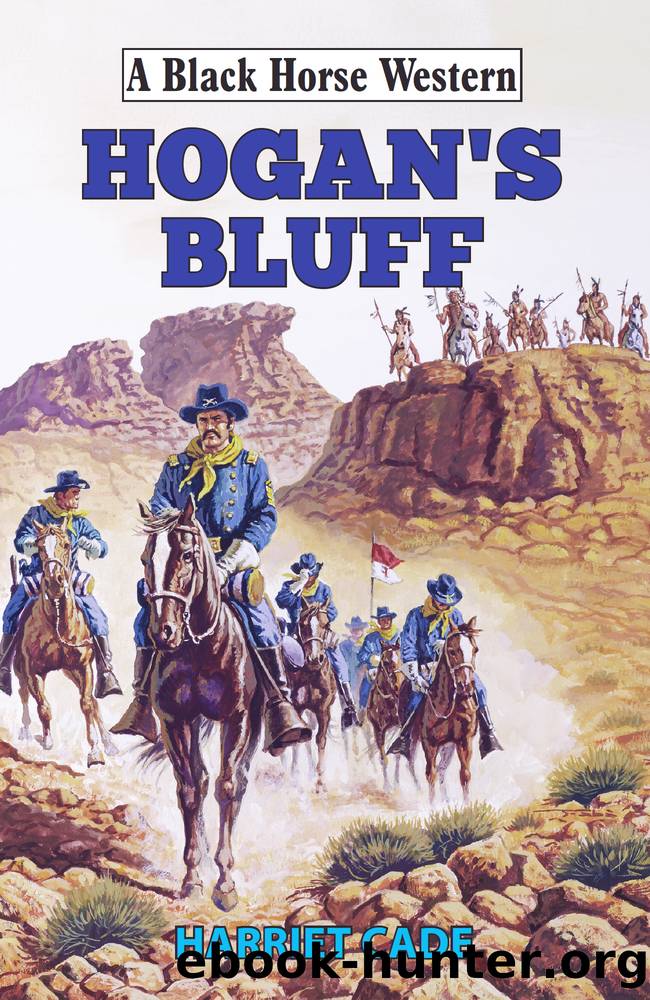
Hogan's Bluff by Harriet Cade
Author:Harriet Cade [Cade, Harriet]
Language: eng
Format: epub
Publisher: Robert Hale
Published: 0101-01-01T00:00:00+00:00
Chapter 5
Three years after the end of the War Between the States, the government in Washington signed a treaty that, it was hoped, would bring a final end to the Indian âproblemâ, in particular Red Cloudâs war, known sometimes as the Powder River War. The Treaty of Fort Laramie, signed at that location on 29 April 1868, set aside a vast tract of land in Dakota and Nebraska, including the Black Hills, which was to become the possession of the Sioux nation in perpetuity. The Black Hills were especially important to the Lakota, a branch of the Sioux, as they were believed by them to be holy. The treaty that promised all this to the Indians lasted just six years. In 1874 a mineral survey team operating on behalf of the government found that the Black Hills of south Dakota contained huge quantities of gold. It was perhaps inevitable that a gold rush would follow this discovery. The gold on the bluff on the Hogansâ land was an outlying vein from these same huge deposits.
To begin with, the US army tried to keep the prospectors out of the Black Hills. Then they began to drive back the Indians, who were intent on killing those who were profaning their most sacred site. In Washington, the government could see clear advantages in a steady flow of gold from south Dakota and thought that this would stimulate the economy generally, which was likely enough true. Using the outraged reaction of the Lakota-Sioux as a pretext, Washington tore up the Treaty of Fort Laramie and carved up the Sioux Reservation into smaller parcels of land, none of which were sufficiently large in size for the inhabitants to live by either hunting or farming. Instead, the Sioux became increasingly dependent on the rations handed out by the Indian Agency. Before this state of affairs was reached, of course, there took place the Great Sioux War of 1876.
The desecration, as they saw it, of the Black Hills by the white men digging for gold served as a rallying cry for the Sioux, who launched a heroic, but futile, war to drive the white men from their lands. The Indians won a few famous victories, most notably at the Battle of the Little Bighorn when better than two hundred and fifty troopers of the 7th cavalry were massacred, but the result of the war itself was never in doubt for a moment. By April 1877, at the time that Andrew McDonald was trying to wrest control of the bluff on the Hogansâ land from them, the fighting had more or less come to an end. On the 23rd of that month, an aide to General Crooke, one of those most vigorous in prosecuting the war against the Lakota-Sioux, wrote to a friend, saying, âI am now fully satisfied that the great Sioux war is ended.â So it proved, for there was to be no more serious fighting after that time, merely a few desultory skirmishes.
By all of
Download
This site does not store any files on its server. We only index and link to content provided by other sites. Please contact the content providers to delete copyright contents if any and email us, we'll remove relevant links or contents immediately.
In Control (The City Series) by Crystal Serowka(36352)
The Wolf Sea (The Oathsworn Series, Book 2) by Low Robert(35372)
We Ride Upon Sticks by Quan Barry(34722)
Crowbone (The Oathsworn Series, Book 5) by Low Robert(33764)
The Book of Dreams (Saxon Series) by Severin Tim(33526)
The Daughters of Foxcote Manor by Eve Chase(23771)
Trainspotting by Irvine Welsh(21965)
Call Me by Your Name by André Aciman(20710)
The Secret History by Donna Tartt(19460)
Shot Through The Heart (Supernature Book 1) by Edwin James(19043)
All the Missing Girls by Megan Miranda(16681)
American King (New Camelot #3) by Sierra Simone(16576)
The Girl from the Opera House by Nancy Carson(15890)
Pimp by Iceberg Slim(14783)
Sad Girls by Lang Leav(14632)
The Betrayed by David Hosp(12979)
The Betrayed by Graham Heather(12955)
4 3 2 1: A Novel by Paul Auster(12608)
Still Me by Jojo Moyes(11466)
